—John, Walter and Greg (with a little help from my friend)
” A woman must continually watch herself. She is almost continually accompanied by her own image of herself… she can scarcely avoid envisaging herself walking or weeping.”
John Berger — Ways of Seeing
“The adjustment of reality to the masses and of the masses to reality is a process of unlimited scope, as much for thinking as for perception.”
Walter Benjamin — The Work of Art in the Age of Mechanical Reproduction
“What once signalled vanity and narcissism is now the very currency of social participation. It is not a good look for the world, ngl.”
Greg Shaw — Extrospect: Selfies, Isolation and the Messianic Spark


AI image, obvs
Not that there were packets of printed photographs kicking around my youth, but sometimes there were some. There was a value involved; beyond the cost from beginning to end (which was significant), there was a moment trapped in film and image that was yet to undergo the radical devaluation of the present. You picked up an envelope of prints, could be 24, could be 36, and would eagerly look through them often forgetting what you might have even taken pictures of, quickly noting the absolute rejects, and any that might have been a triumph.
And of course, you looked for images of yourself.
But it was different – you would not want to be seen doing so. You would not shuffle through the pack looking for where you might appear, and you would not get caught lingering over a picture of yourself. That was vain and egocentric. It reflected an unpleasantness that was not culturally acceptable. Cast forwards two decades to the carefully taken, selected, curated plethora of selfies, from casual individual to 100k follower influencer; fashion, food, sports, music, art, goodwill, soft-porn, literally “whatever”, and note the ego-centric, underlinings of a so-called “meaningful” life, this is me, I am here, this is for you (but really for me). Of me, for me. Me, me, me.
The cultural inversion that has taken place is nothing short of staggering. What once signalled vanity and narcissism is now the very currency of social participation. It is not a good look for the world, ngl.
[I have been contemplating this change and the plague of the selfie but instead of decrying and lamenting the situation (so mature) I turned to two of the king-pin theorists of the twentieth-century, guides to understanding representations of ourselves and mechanical reproductions: John Berger, the critic of images and the gaze, and Walter Benjamin, the philosopher of aura and reproduction. Berger’s argument [was] that the female] subject was not simply depicted as she was, but as a representation of how she might be, in the knowledge that she is being watched. She is both the object of the gaze and the subject of her own self-surveillance. It is arguable, that in some regard the selfie is empowering and gives agency to this subject. Benjamin asserted that the reproduction of artworks (in this instance the portrait) causes a loss of “aura”, their unique presence in time and space. It’s possible that for Benjamin, the selfie was the logical endpoint of mechanical reproduction to this process — born as a copy, ready for circulation, replication and deletion. Here, the aura is not diminished, but absent.
In the spirit of a “loss of aura”, and an age of mechanical (re)production I turned to Chat Greg’s Play Thing and had really a most enjoyable evening. I controlled and adjusted parameters, manipulated a bunch of responses, interacted for a night and evolved a fake conversation between the theorists about the subject.
Fake, writing about Fake things.
Berger and Benjamin Scroll Instagram
What follows is an imagined dialogue between John Berger, author of Ways of Seeing (1972), and Walter Benjamin, author of The Work of Art in the Age of Mechanical Reproduction (1936). It stages their voices in the present, reflecting on the flood of selfies in our digital age.
Berger:
“These millions of images of faces, held at arm’s length, do not show confidence. They show hunger. The omnipresence of the selfie is testimony to a loneliness we dare not name. Once, recognition came from the embrace of family, the closeness of comrades, the presence of neighbours. Now, people prove their existence by offering their likeness to an anonymous crowd. I am here, I matter — said to no one in particular, to everyone and no one at once.”
Benjamin:
“You see alienation, John, and rightly so. But I also see a different current running beneath. Every selfie is a trace, a fragment of life otherwise invisible to history. In each image a weak messianic power stirs: the power to redeem, to inscribe one’s presence against erasure. A factory worker, a refugee, a teenager in a village — their likeness circulates where once they would have vanished unrecorded. The banality of the form hides its potential.”
Berger:
“But Walter, these images are devoured by the platforms that host them. They generate revenue for corporations, not solidarity. The gesture of seeking connection ends in further isolation. The selfie replaces presence with appearance, companionship with spectacle. It aestheticises absence.”
Benjamin:
“True — yet dialectics always contain their reversal. The very image that is consumed as spectacle may later become testimony. A protester’s selfie today, mocked or ignored, may tomorrow be evidence of resistance. Even a frivolous image can, when history shifts, reveal what was otherwise lost. The trivial frame may hold a fragment of redemption.”
Berger:
“Then we are agreed on this much: the plague of selfies is not merely narcissism, but a symptom of our times. It tells us of loneliness, of the erosion of communal recognition. But it also tells us of longing — longing to be seen, to be remembered. That longing itself is not contemptible. It is human.”
Benjamin:
“And in that longing, we glimpse both despair and hope. The despair of fragmentation, and the hope that even the smallest image may, one day, illuminate the forgotten. Alienation, yes — but also the faint spark of messianic redemption.”
[They fall silent for a moment, watching the endless scroll of faces on nearby phones.]
Berger (softly):
“It is strange, isn’t it, Walter? Once, images were rare — painted to preserve status, devotion, memory. Now they arrive in floods. And yet, the more there are, the less they seem to connect. Each face is vivid, but the gaze passes over them like water on glass.”
Benjamin:
“Yes, John. The flood both drowns and preserves. Each image is trivial in isolation, but together they form an archive of the ordinary. A century from now, a historian may stumble upon these faces and see, not spectacle, but testimony: how people dressed, how they smiled, how they wished to be remembered.”
Berger:
“But what kind of memory is it, when the image is crafted for strangers? The child once showed her face to the family album. Now she shows it to no one in particular. The audience is diffuse, anonymous. That is why it feels so lonely.”
Benjamin:
“And yet the loneliness may itself be redeemed. For even in anonymity, there is the spark of presence. These countless self-portraits are, in their own way, a weak messianic gesture — proof against erasure. They whisper: I was here, in this body, at this moment.”
Berger (pauses, nodding):
“Perhaps. But still, the noise of circulation is deafening. To be seen has become a compulsion, and absence a kind of shame. The price of visibility is that one is never allowed to vanish. Even solitude must now be posed, posted, performed.”
Benjamin:
“That may be so. But recall, John: I always believed redemption hides within catastrophe. Even in the flood, one may find fragments that glimmer with meaning. And so perhaps, in this endless scroll, lies the faint chance that some overlooked life will shine through, carried forward by the very medium that consumes it.”
[They both return to watching the glow of the screens, their silence heavy, but not without hope.]
Berger and Benjamin Join the Feed
I felt, with a little more help, I could do more to really nail this dialogue. In the sprit of the age of sheer reduction, I thought John and Walter could comment on actual IG posts? So, with refined parameters, and imagined IG accounts for our theorists, and some influencer accounts from the blue, we set to work. The process took a while to get to where I wanted, with the final instruction below:
“Let’s re-stage the conversation we just developed (Berger’s selfie as testimony of isolation and Benjamin’s selfie as messianic possibility) as if it were playing out in the comment sections of Instagram posts. We’ll use the same handles we invented earlier:
@johnways_ofseeing , @walter_mechrepro
And drop them into the influencer accounts we created:
@fitgrind365 (fitness influencer, @teenqueenxo (teenager), @velvetafterdark (OnlyFans model), @keysandcoffee (pianist)”
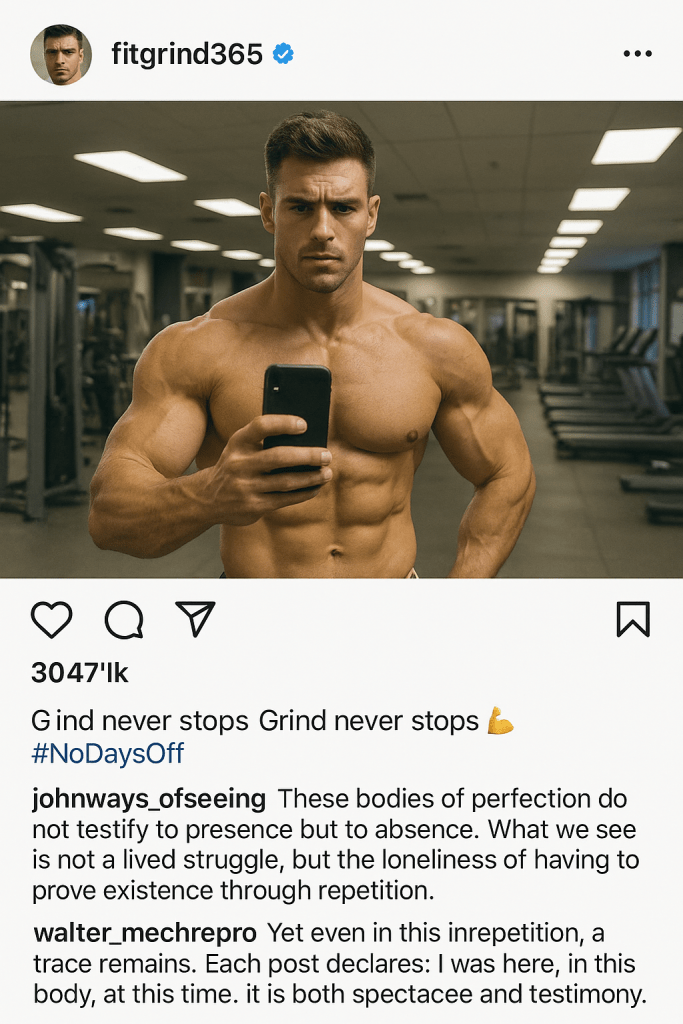

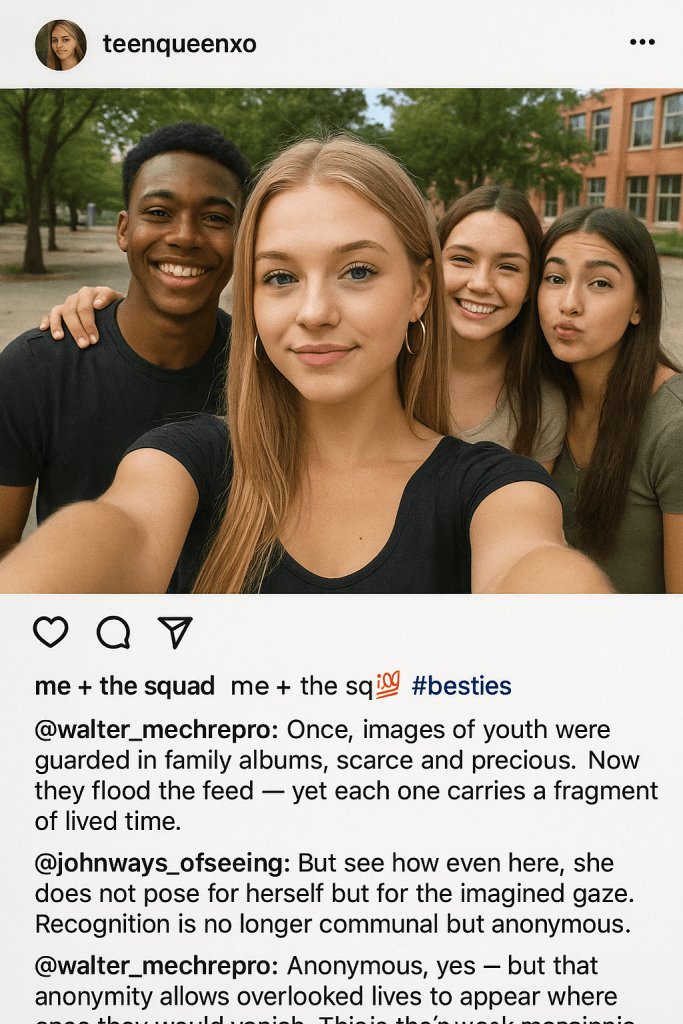


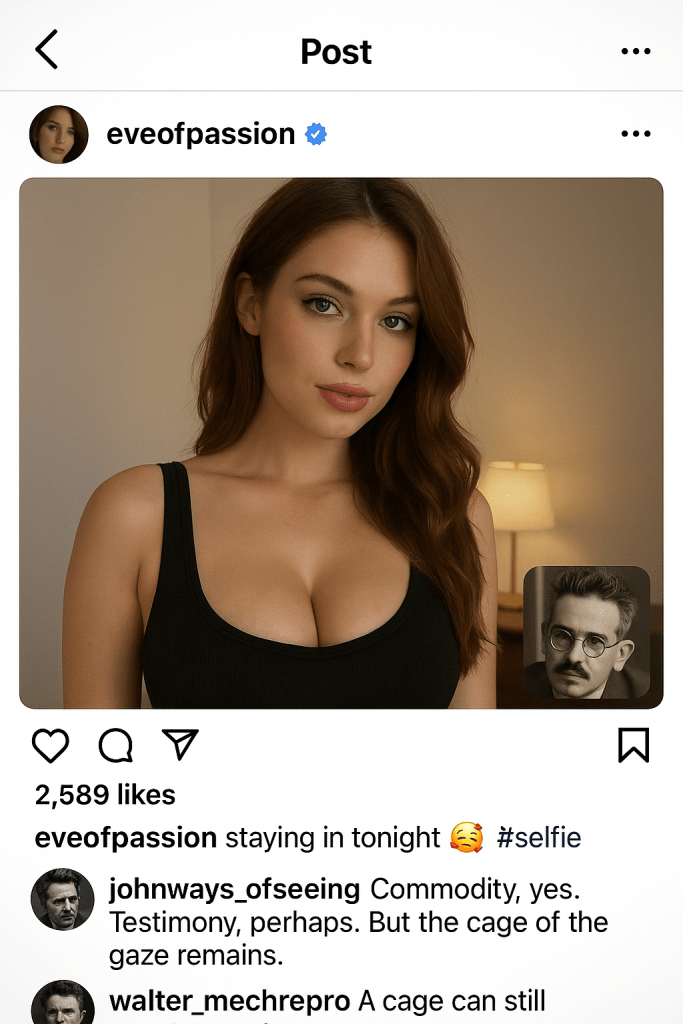
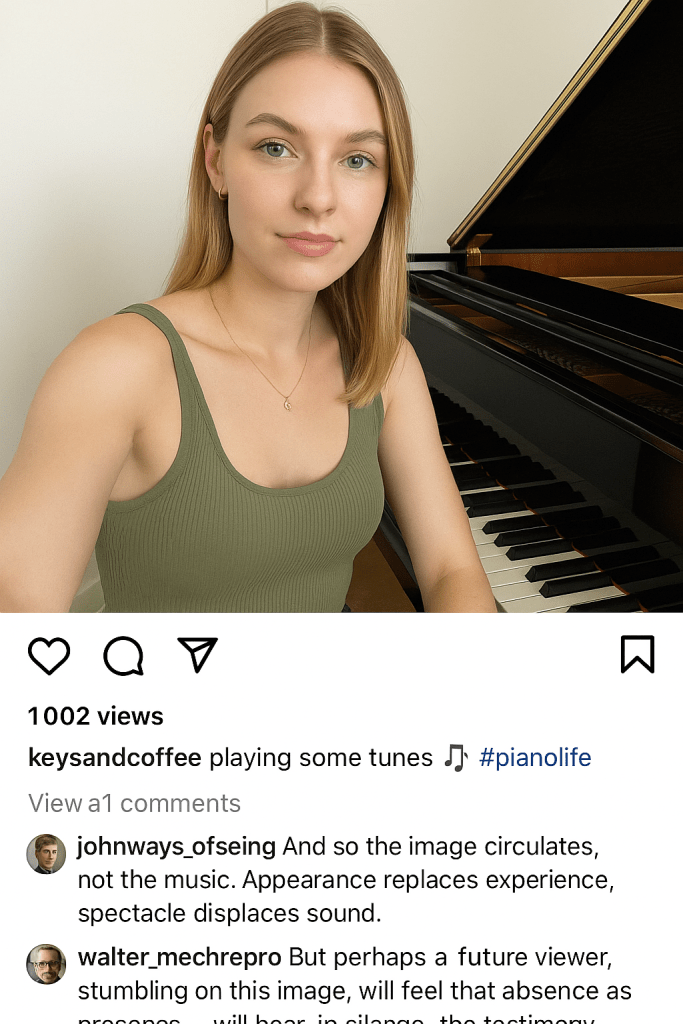
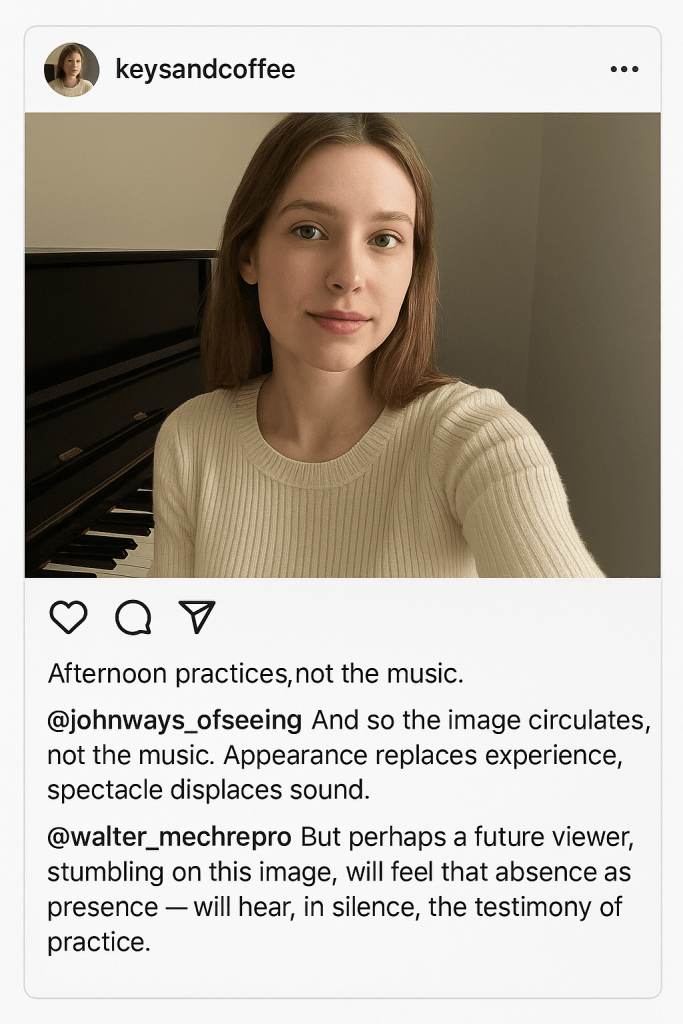
It is, I think, the inconsistencies and flaws that make these so intriguing. There is so much that could be unpacked, the mind boggles, not least that these are entirely generated images, not a screen shot with text comments. There is so much that is alarming but as much as that is the results, I think have been worth the effort. I am in two (or more) minds as to what the result would feel like if I had made it “accurately”, without imperfections and relying on my own intellect entirely. Different, better, worse. But it would have missed the enquiry embedded in the form that this possesses, for whatever that is worth.
G ind never stops Grind never stops
Greg Shaw, Harare.
 Greg Shaw
Leave a comment