Category: Art Education

  • The Unfulfilled Promise: An extraordinary student work

    “Poor is the student that does not surpass his master.”

    Leonardo da Vinci


    The cycle continues. The UVI artists, some of whom have inhabited my studio for six years have moved on, once again. In their place I find my slightly deranged (at least en masse, and in the nicest possible way of course) class of 2016. I believe I mentioned them once before, and have little doubt that I will in future.

    IMG_7587

    Above, is the 2015 class with whom much fun was had, and from which some quite extraordinary work emanated. They look deceptively cheerful and refreshed, following the extraordinary toil of the A2 Coursework. And they look considerably smarter than usual, are not doing hair, nor are they hatching small creatures prematurely, all of which was known to have happened. Unfortunately the corner is cut off of the picture. I think it is symbolic of Raphael, who did not make the picture, or the exhibition of their final work. Sorry dude. Pity, he was the only male student of the year group.

    List of Possible Reasons that Few Male Students Take Art:

    1. It’s for “whooses”;
    2. It’s for the academically challenged (which is not the same as);
    3. He’s a real high flyer – destined for the sciences;
    4. It’ll get you nowhere in life (unless you want to teach which is really the same thing;
    5. Neither of [his] parents (or grandparents) can draw a stick man.

    Studio One

    I wanted to write a post about this extraordinary work, the final outcome of ex-student Amike du Plessis. I have been putting it off until the Cambridge results were released, but also because of other factors: It is a work of such magnitude, that I can say it is without question, the most ambitious work ever produced by a secondary school student that I have ever encountered. Comprising more than 3000 nails and a life-size paper cast of a figure, it arrests the spectator with such extraordinary force that on encounter, one is literally left quite stunned. I will be as bold to say that it is a work of that holds its own within, indeed, is an important contribution to, the contemporary Zimbabwean art scene, and I hope one day to see it exhibited in a wider context.

    In this regard, it deserves a thorough and careful reading, which I will write at a later stage. I have been a spectator to the process of creation, and advisor to the student, and think that some space would be beneficial before writing that analysis. I wondered how I would present it in a blog post until I found the opportunity in the February edition of Harare News in which the following Zimbabwean statistics are recorded:

    1. 2 in 3 women experience some sort of violence in their lifetime
    2. Over 40% of cases are not reported to anyone. Survivors rarely seek help.
    3. Mashonaland and Masvingo are the provinces that have the highest prevalence of child marriage – well above 40%
    4. 43% of adolescents aged 13-17 had their first sexual experience forced.
    5. 47% of adolescents aged 13-17 years [old] experience sexual violence and rape multiple times.
    6. 1 in 3 women aged 18-24 in Zimbabwe has experienced sexual violence before the age of 18.

    (Mudzonga, T. 2016. “Gender-Based Violence: the hidden scourge”; Harare News. Issue 29, February 2016.).
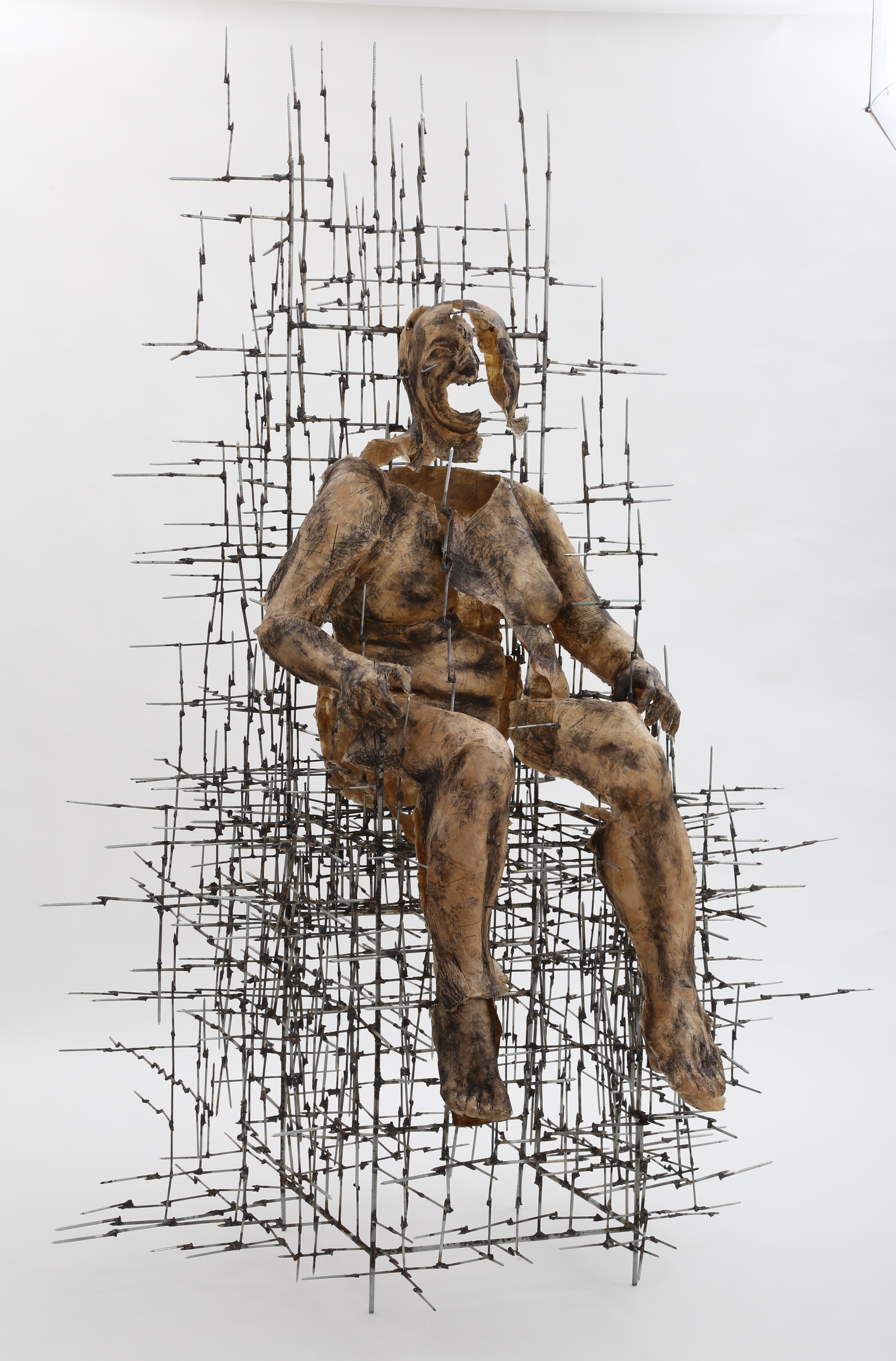
    Amike du Plessis, 2015. “The Unfulfilled Promise” . Nails and Paper, height 218cm. (Photograph by David Brazier).

    It is observed that the students of a privileged private school have little to do with the environment presented above. I would argue, that in the face of these egregious statistics, how could they not? Further to that, GBV is only one of many possible starting points of the work. Viewers find meaning, it is not embedded in the work, as is so often observed. Perhaps we should find or consider the structures of a patriarchal society and the insidious behaviours that permeate almost every aspect of our society, the domestic arena; the public arena? Have these structure not conditioned our own histories? Do they not permeate the multitude of cultures, of ideologies and religions that grip so tightly onto our present existence, whether of privileged realms or other? As Mudzonga writes: “We live in a society that endorses and perpetuates an extraordinarily fixed hierarchy that cuts through all social conventions.”
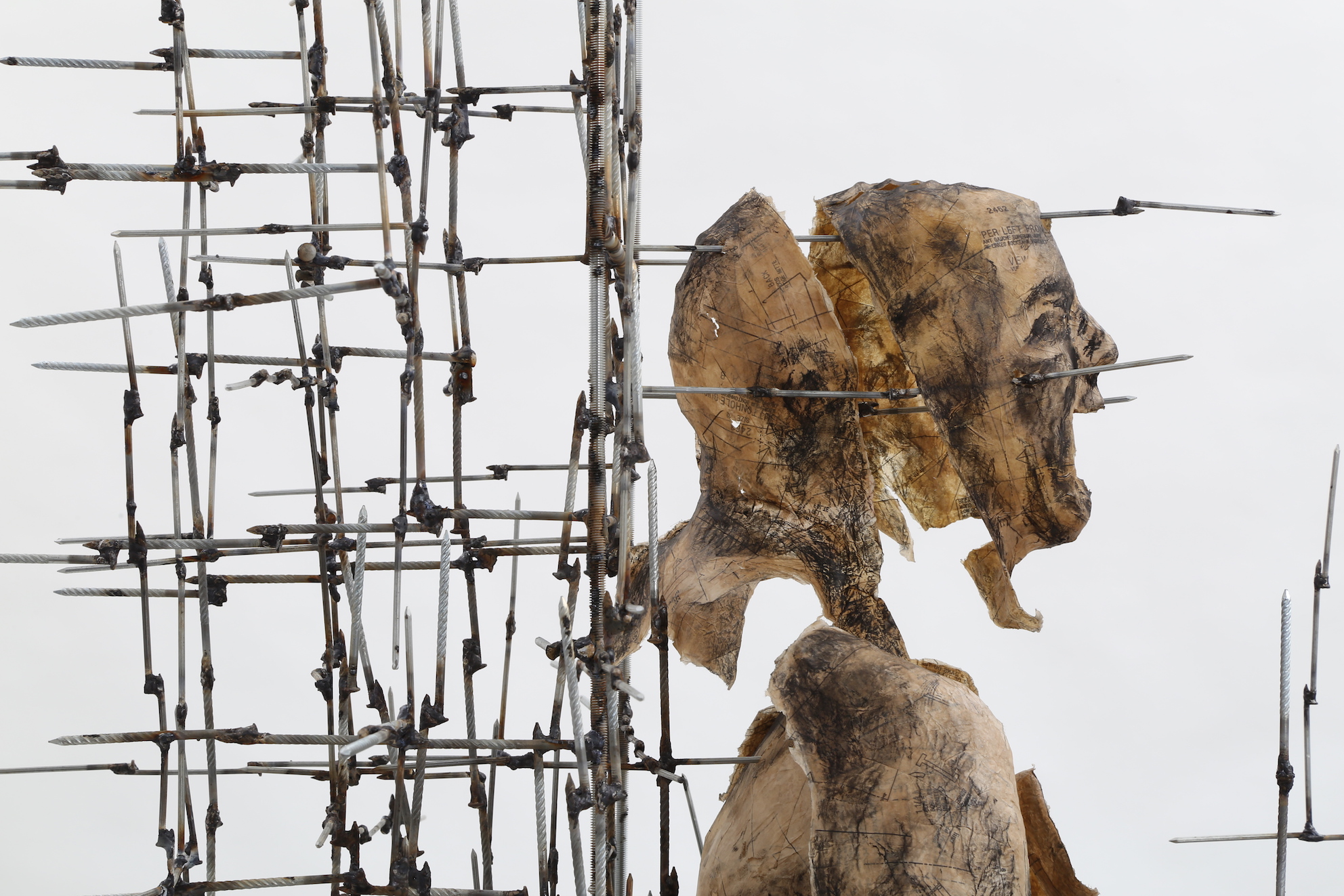
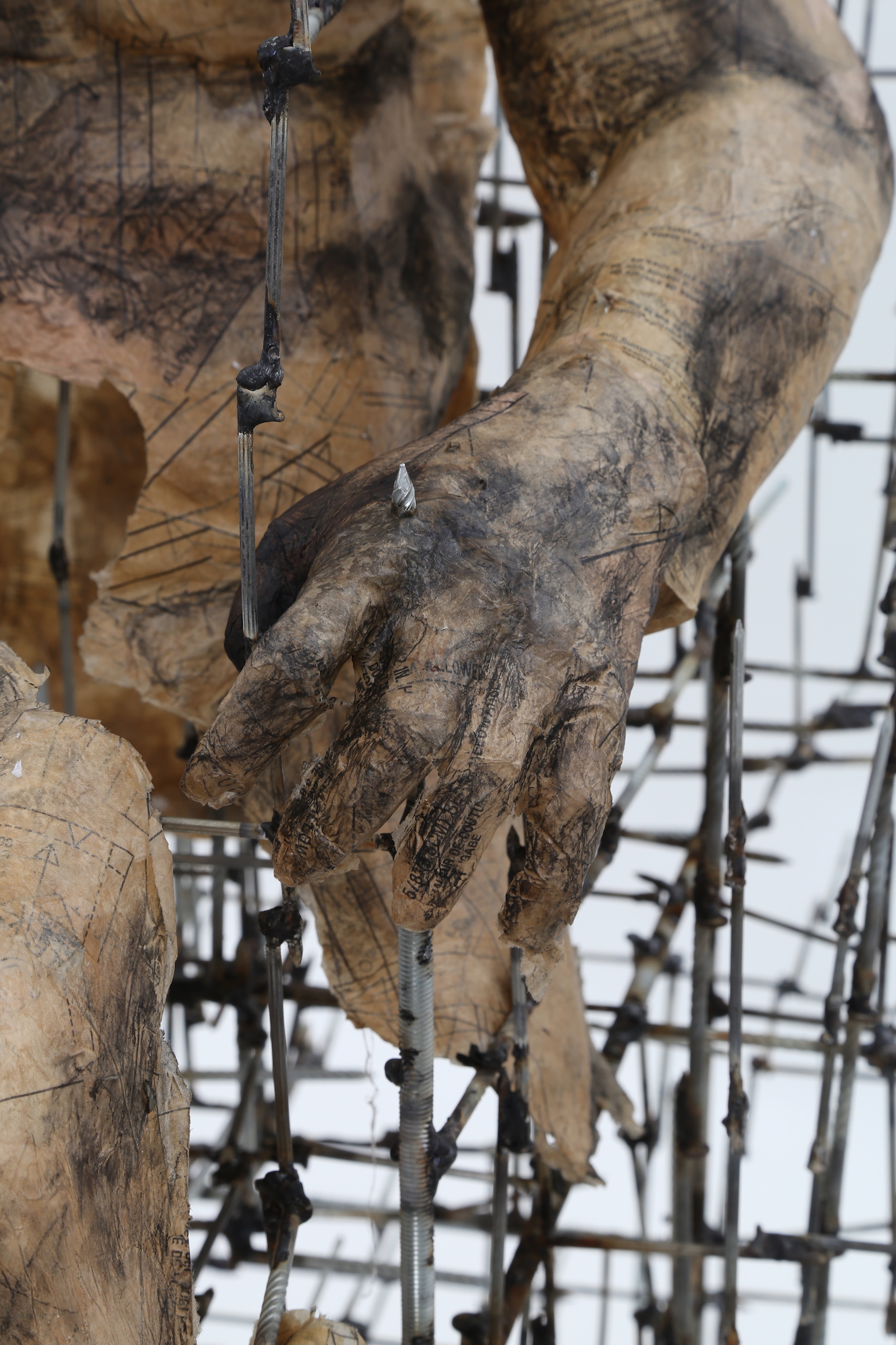


    Amike du Plessis, 2015. "The Unfulfilled Promise" (Detail). Nails and Paper, height 218cm.
    Amike du Plessis, 2015. “The Unfulfilled Promise” (Detail). Nails and Paper, height 218cm.
    CI2A3026
    Amike du Plessis, 2015. “The Unfulfilled Promise” (Detail). Nails and Paper, height 218cm.
    Amike du Plessis, 2015. "The Unfulfilled Promise" (Detail). Nails and Paper, height 218cm.
    Amike du Plessis, 2015. “The Unfulfilled Promise” (Detail). Nails and Paper, height 218cm.


    I believe unequivocally that the arts are not some redundant field reserved for the incompetent, whimsical, non-academic, non-achieving members of society. They are the realms of some of the deepest thinkers and most courageous of people and provide a means of reflecting, recording, challenging and opening dialogue about the very nature, the make-up and intrinsic qualities of our existence.

    In this regard, as a husband and parent of two daughters, in the face of statistics that give my children a 57% chance of not experiencing sexual violence in their teenage years, what the hell would I be doing if I do not allow or even encourage my students, whether or not privileged, privately educated, or empowered by some other means, to engage with these themes? I would most certainly consider that a failure of some magnitude.

    “It is a tricky, dangerous, insidious practice, which is why it is so prevalent, and so hard to talk about. But it is a conversation we must have” (Mudzonga, T. 2016. “Gender-Based Violence: the hidden scourge”; Harare News. Issue 29, February 2016.)

    OBSERVATIONS

    1.Mudzonga does not provide sources for the statistics in the article. However, with only the slightest bit of scratching, the figures that are widely publicised make for some horrific reading:

    At Least one Women is raped every 90 minutes in Zimbabwe (http://bulawayo24.com/index-id-news-sc-national-byo-50485.html) .

    Msasa Project records 300 cases of violence against women mthly.(https://www.newsday.co.zw/2015/04/24/rise-in-rape-cases-cause-for-concern/)

    15 Women are raped every day in Zimbabwe – Zimstat – (http://www.thestandard.co.zw/2012/08/15/15-women-are-raped-everyday-in-zimbabwe/)

    There are numerous reports of this nature which cross our paths only too often.

    3. The photographs of the work have been taken by the exceptional artist and photographer David Brazier, to whom I am exceptionally grateful.

    2. The process of marking Art is a difficult one, especially as (correctly so) current art theory has dismissed the formal analysis of works, and with that, any independent standards (a topic that demands considerably more discussion). It is worth noting however, that all Cambridge coursework is marked by the respective teaching centres and moderated by Cambridge. Whilst the motivation for this is primarily for practical reasons, it also provides the various submissions to be read in the context in which they were created. In my view, this is very significant, especially as one of the four Advanced level marking criteria is “Knowledge and Critical Understanding”, which provides space for analysis of the work in it’s own cultural context. Our submissions are typically marked by three teachers, and our marking and reports analysed and moderated by the examination body.

    3. In what seems a different era, I had a dog called Jezebel, whom I trained, or attempted to do so. I met a man who became my friend, Gordon, an extraordinary dog handler and trainer, who I am confident in saying has notched up more obedience champions than anyone else in this country (as well as numerous records in other disciplines of dog competition). He once told me that the highest achievement he could imagine would be for one of his students to surpass his achievements. At the time, under the influence of youth and I suppose my own delusional, mis-placed sense of self-importance, I was quite shocked. 20 years later, I am happy to agree with him, and also to note da Vinci observations above.

    Greg Shaw, 6 February 2016.


  • Roar Meet

    “Each second we live is a new and unique moment of the universe, a moment that will never be again. And what do we teach our children? We teach them that two and two make four, and that Paris is the capital of France. When will we also teach them what they are? We should say to each of them: Do you know what you are? You are a marvel. You are unique. In all the years that have passed, there has never been another child like you. Your legs, your arms, your clever fingers, the way you move. You may become a Shakespeare, a Michelangelo, a Beethoven. You have the capacity for anything. Yes, you are a marvel. And when you grow up, can you then harm another who is, like you, a marvel? You must work, we must all work, to make the world worthy of its children.”

    -Pablo Picasso

    Photos beside my desk: Top centre is Picasso with his son, pictured in the beautiful photograph by Robert Capa, and of course my family, Hannah Eden and Shaunagh, in the others
    Photos beside my desk: Top centre is Picasso with his son, pictured in the beautiful photograph by Robert Capa, and of course my family, Hannah Eden and Shaunagh, in the others.

    We finished our final art exams for the term on Sunday. Form Three exams, an enjoyable period, where innovation and creativity is awarded as highly as technical skill. I am happy to say that for the most part, the ‘Threes came to the party! Our Art exams are quite well structured, with an emphasis on coursework and preparation, and only a part based on actual “controlled testing”. For the most part, I am an examination hater (h8r): The Art of the Short Memory Test: of Information that will Never Need To Be Recalled On The Spot Again. Unless I suppose one is a first-responder, or in some other crisis situation, or watching The Chase, etc. …. Of course there are the aspects of applying knowledge, and testing understanding of concepts; I get that. But still.

    List of things I personally dislike about writing examinations:

    1. Studying.
    2. Writing examinations.

    Let me not be mis-understood in regard to learning; I love that! And I love research and understanding, projects and creating, and most of all growth, which is I think what this post is about.

    Picasso is famously quoted as saying “all children are artists, the difficulty is to remain an artist as one grows up.” I know this is true; my eldest daughter painted this this when she was very young:

    Hannah, Acrylic painting , 30x30cm.
    Hannah, Acrylic painting , 30x30cm.

    She still makes beautiful art, but now with a little more self-consciousness, embodying Picasso’s words above. The youngest daughter does not suffer from that affliction yet. Hopefully never, though that is wishful thinking. There is too much process in the way; we are too enmeshed in the system, not to mention peer/teacher/parent expectation, nor I suppose the expectations of the self. But she is not there yet, and in recent months we have seen some extraordinary creations. Approximately 14 A4 sheets were glued together into a long scroll, which was illustrated and coloured from end to end. It included statements and conditions, being a petition against eating pigs which we were all invited to sign.

    She loves pigs, this is a drawing of a rainbow pig. It can fly:

    Eden, Rainbow Pig.
    Eden, Rainbow Pig. A4

    But it was the drawing below that motivated this post. This is a drawing of a crocodile in search of uncooked protein. It could also be a crocodile that is very vocal, in search of protein, or a crocodile that is in search of company. It was with delight that I stumbled on the work on Sunday evening, and also with the vaguest tinge of dismay, with the realisation that after more that 25 years of art-making, I will ever be able to make a drawing like this without it being utterly contrived:

    Eden, Roar Meet. A4, pencil on paper
    Eden, Roar Meet. A4, pencil on paper

    I suppose in honesty, that it is the ROAR MEET which is the highlight of the drawing, and that most likely there are many readers decrying the employment of some quite suspect English (H8RS!!). Thankfully, 1: Dealing with that aspect lies in the more than competent hands of my wife, teacher extraordinaire (it is “her ticket”), and that 2. The Art aspect seems to be well in control.

    Those who are not too busy hating on the English may sense the extraordinary contour line of the reptile, at its most exquisite on the arch of the back, sway of the tail and along the bottom jaw; Perhaps some sense the quite spectacular relationship between positive and negative shapes formed between the land and animal, most profound in the relationship between speech bubble and jaws! Most students of art would understand that once a corner has been cut off from the composition, like the bottom left above, there is no way back – except that somehow, by virtue of the open ended triangle beneath the tail, a delicate balance is achieved.

    Perhaps the more perceptive will notice how at the juncture of the lines that describe the land, a really strong suggestion of spacial recession is created. I cannot believe though, that anyone would look long enough to notice that the very same juncture seems to be reflected in the chance meeting of the base of the “A”, and the top of the “T”.  And I am almost certain, that only a select few (perhaps those schooled by the venerable Martin Van Der Spuy) would observe the employment of the concept of Theme and Variation, observable in only the most exemplary of draughts-people: Where the arrow of the speech bubble establishes the visual theme, the line of teeth takes the form, repeats it in the first variation. The line of spikes along the spine form the third variation and  the scales on the body a fourth…. If they noticed that, they may too have understood that the structure of the feet is directly inverted, varied and repeated in the structure of the grass, and that in both forms, they relate to the initial theme).

    Why else would this drawing hold together so beautifully?

    But I am not suggesting that Eden is some sort of child prodigy, or that she is in any way more accomplished of better than any one else’s child (she is, so is Hannah, but I am not saying that). The point is that like all of our children, she makes beautiful pictures, over and over again. And she tells stories and voices her ideas. And it is our remit (since we  have the absolute privilege, not only to provide education for our children, but also to teach them), not to bugger that up.

    There is hope.

    As I have written, the Upper VIs have departed (leaving a hole), submitted their sketchbooks, portfolios and research components and we await their results eagerly. But the result is only a part of the story – the rest is the growth and learning that has taken place during their time in studio. This goes beyond the visual arts, I hope that they leave having learnt a whole load more than that, as I have, from them. Nevertheless, if this growth can be measured within their work, maybe that is something.

    One of them. Kayla, found her Form One sketchbook, and brought it in to show me. Here is the first homework drawing that she made for me, six years ago.There are many good qualities about the drawing, and during the course of that first term, her drawing improved considerably.

    Kayla, cup. 20 x 25cm, pencil.
    Kayla, cup. 20 x 25cm, pencil.

    Here are some of her more recent works, in various media:

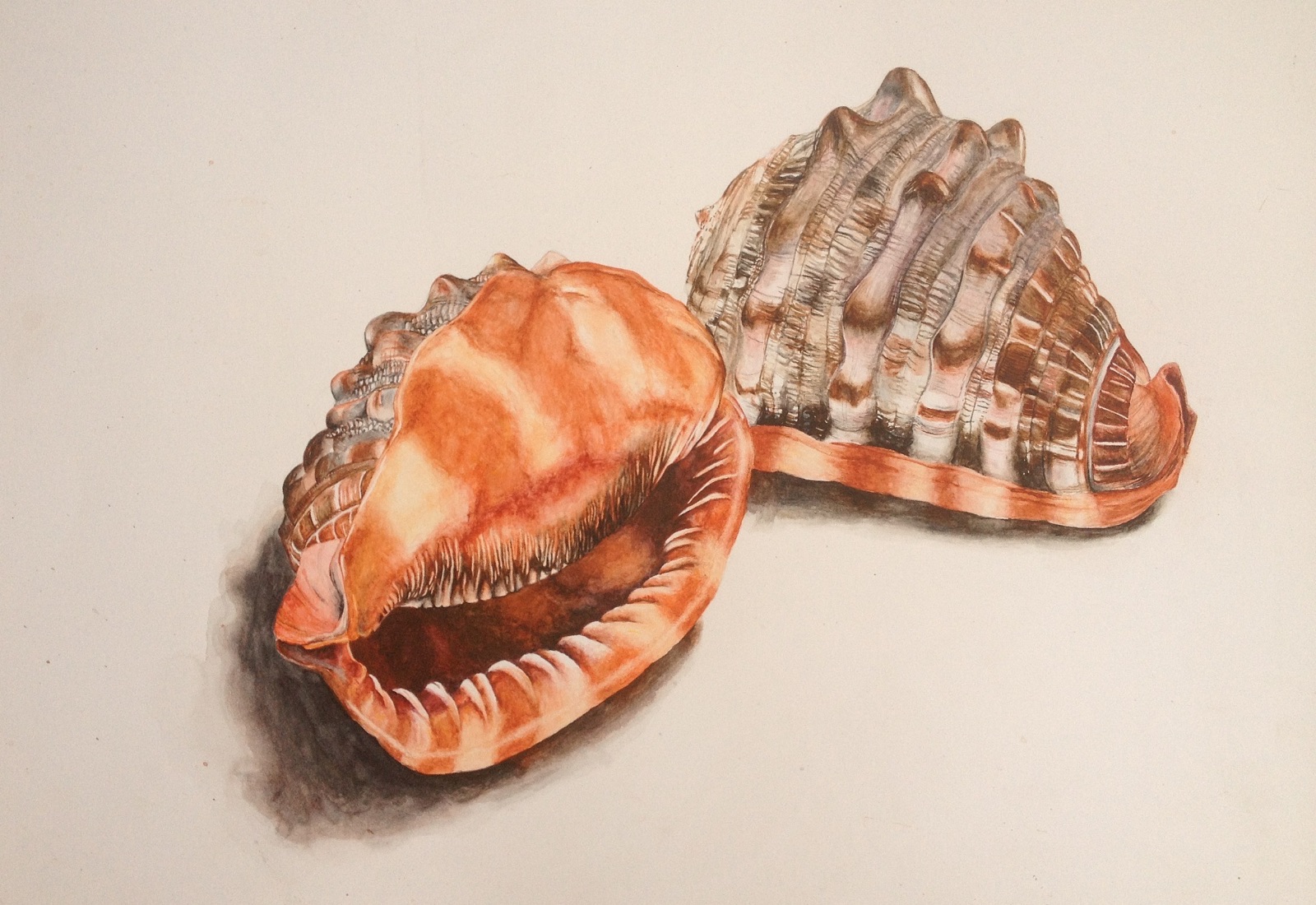
    Kayla, Shells, mixed media. Approx A3
    Kayla, Shells, mixed media. Approx A3
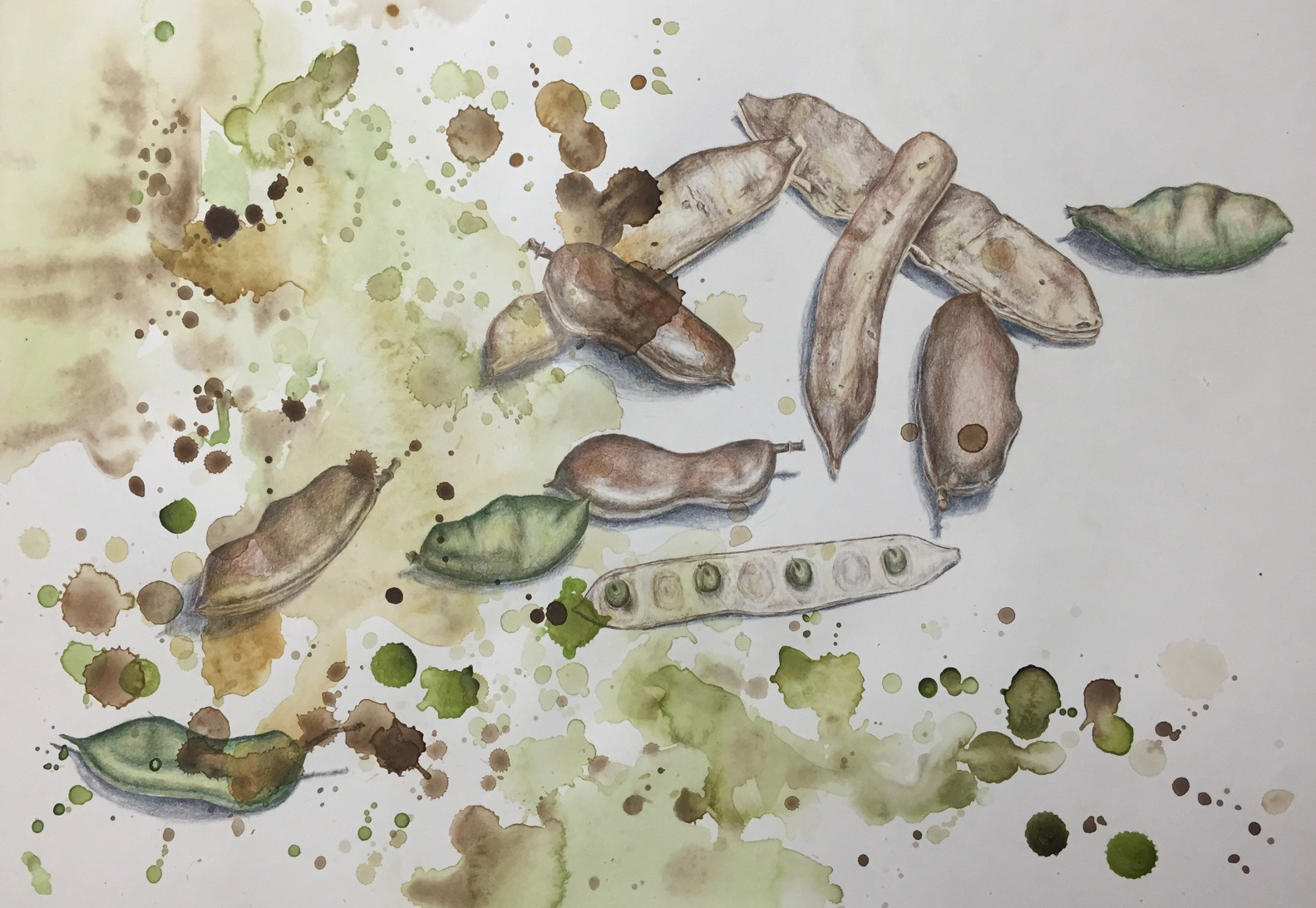
    Kayla, Seeds and Beans, Mixed media, A2.
    Kayla, Seeds and Beans, Mixed media, A2.

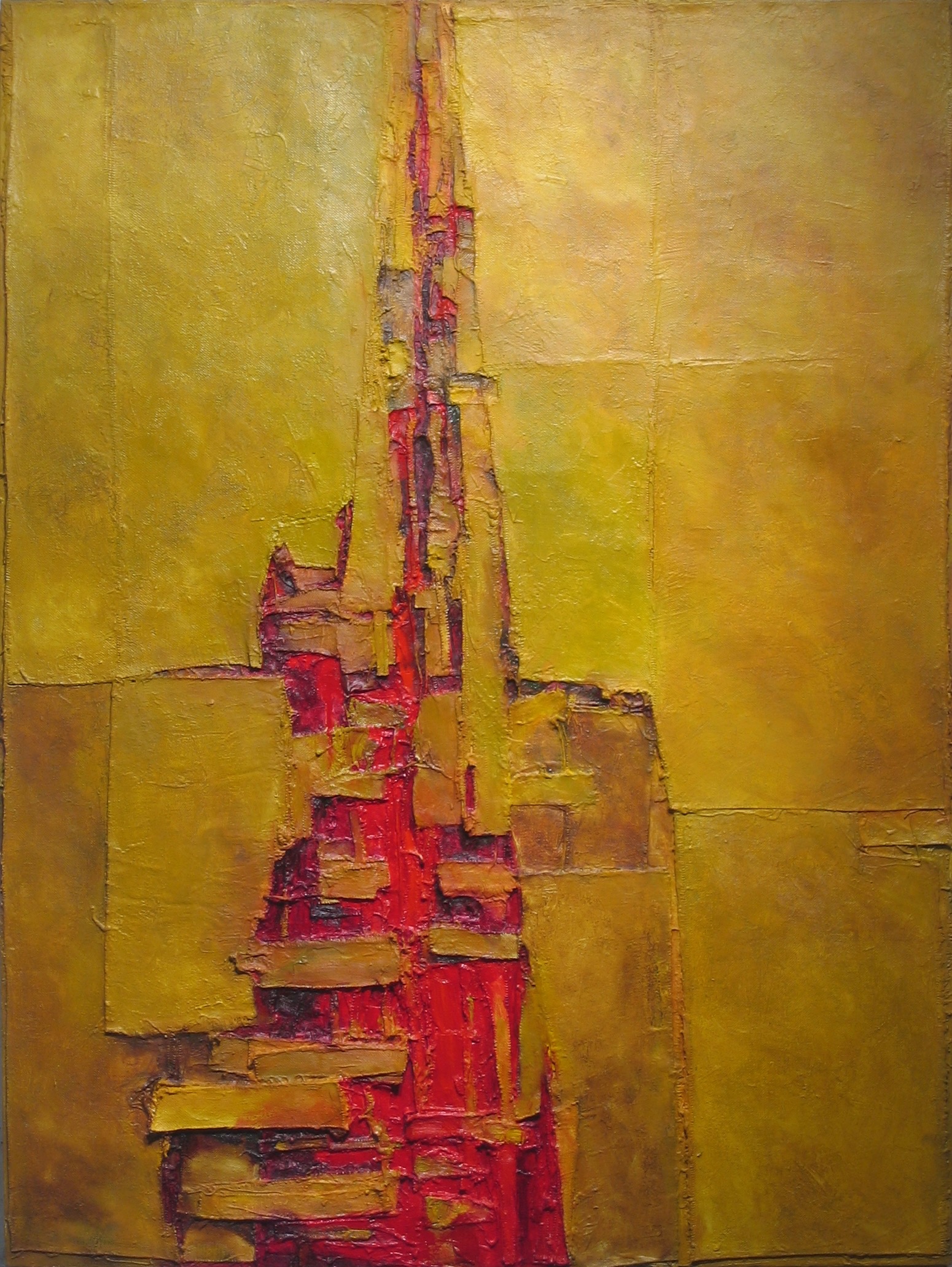
    Kayla, Chongolongo [sic]. Mixed media, A2.
    Kayla, Chongolongo [sic]. Mixed media, A2.
    Her work is very beautiful, and to see this small strand of this section of the journey laid out as such provides me with some optimism; that in the future, there will be places where people might not say:

    “it’s Raw meat…”, but instead,

    “how unique, how marvellous”.

    OBSERVATIONS

    1. A total of 41 hours of exams have been written this term, although there was an 8 hour overlap. Typically, four of us invigilate simultaneously, making it a quite substantial input into the process.
    2. Martin Van der Spuy remains one of the most highly regarded teachers of art that has passed through this country. His influence is seen throughout many of the most highly regarded painters of the past two decades.
    3. Hannah still draws beautiful works.
    4. Eden remains obsessed with pigs.

    Greg Shaw,10 November, 2015.

  • Razor wire, a gash and some burnt wood (Part 1)

    “My songs have nothing to do with war. They are all about the sad insecurities of a balding rock star”

    – Chris Martin (The Guardian 17 March 2003)


    I picked a piece off of a painting and painted the hole red. It looked like a small wound in flesh. The surface had been afflicted. It was a small wound, it could be construed to have been caused by a sharp stick. There were also scratches, quite deep I suppose. There was a slight translucency in the layers of oil, which spoke to me of a sort of bruising. Once, when I was using my sisters stilts, I slipped. There was a rusty screw sticking out of the handle, and it stuck me hard in the shin. It made a hole right into the bone, quite deep. I never talked about it because of the fear of going to hospital.

    Minimal damage.

    Contained.

    My painting spoke nothing of the carnage that was created and endured at that time. Perhaps that was not the objective. Perhaps that was simply too big to consider. But as a hole in a dam, a picked scab, the injury beneath a toyed with, nuisance piece of loose skin grew and grew: Visually, physically, contextually. I engaged with that initial hole, that small puncture wound. It was the beginning of an obsession with surface and texture, with representation and literalism that would endure till the present.

    This is Part 1 of a post about that preoccupation. I write it as my work “Elegy” hangs on the Art/Artefact II exhibition at Gallery Delta, a work a long way from the painting described above. I don’t think I can really speak about it without writing of one element of it’s history, which is what I shall endeavour to do here. I will post the second part next week. (The painting with the hole (Scratching the Facade) formed part of the 2005 exhibition “Embers of Dreams”.

    Scratching the facade, 2005. Oil on canvas. 120 x 80 cm
    Scratching the facade, 2005. Oil on canvas. 120 x 80 cm
    The Elusive Dream, 2005. Oil on Canvas. 120 x 164.
    The Elusive Dream, 2005. Oil on Canvas. 120 x 164.

    Between then and the present lie a collection of stories of corrupted foundations, damaged structures, isolation, wounds and destruction. Stories of despair, defence, of light, of patience. Of burning, embers and ash. Not ash. Ash has less value – it is a symbol of something departed – it is hard to work with, grey, lacking contrast, lacking substance. Stories that end with charcoal. Charcoal is different. It has another quality; It’s dense, black. It has substance. It possesses the power to be rekindled. Charcoal is potential.

    As the wounds grew, so did the necessity to represent them. The acrylic/plaster base became insufficient for the task. Scratches and punctures were no longer the nature of the environment. In search of a sense of greater depth, I took to ripping and layering pieces of canvas, still incorporating the earlier base. There was a transformation taking place; what began as a representation of a wound, gave way to an actual rip and tear. The surfaces which had until now seemed to form a bridge between the abstract and the figurative became literal embodiments of the ideas about which I was thinking. I didn’t ever name the parts, though the surfaces seemed to reflect different aspects. In one a type of skin, in another, panels or rusted metal, in a third burnt panels, broken, insufficient to cover or piece together the carnage. I worked on numerous pieces at a time, as over the layers of canvas, were numerous layers of oils – glaze upon glaze. I think that they had a richness and depth, from memory they were strong, resonant images. Amidst them were moments of light, of dreaming an hope.

    The works below are of that era. They were part of the 2007 solo exhibition “The Valley of the Shadow”.

    Wound, 2007. Oil on Canvas, 120 x 90 cm.
    Wound, 2007. Oil on Canvas, 120 x 90 cm.
    Staunching the Wound II, 2007. Oil on Canvas, 40 x 48cm
    Staunching the Wound II, 2007. Oil on Canvas, 40 x 48cm

    The culmination of these ripped and layered works ended with: “Enough Said”. What a load of crap. An total misnomer. As if there could have ever been enough said.

    List of paintings that I can think of that (when standing alone) are truly able to describe horrific moments:

    1. Guernica.

    Not that I would rename it, it was a good title. I think for me it was enough said. It marked the end of a two and a half year obsession with those stories, and those processes. It was painted for the 2008 HIFA exhibition, “determine: Nation”, at the National Gallery. At almost two metres in height, it was somewhat overbearing, the colours were strong, the composition had some tension. It remains for me a really significant painting, one I am proud of.

    Enough Said, 2007. Oil on Canvas. 140 x 180 cm
    Enough Said, 2007. Oil on Canvas. 140 x 180 cm

    OBSERVATIONS

    1. The product DM6, was an acrylic base which dried into a transparent flexible and extremely tough surface. It had the added property of being extremely sticky. It was developed by Peter Eyllis of Pigmento, as far as I understand, with a certain amount of artistic input from his sister-in-law, the renowned artist Helen Lieros. It is a product no longer readily available.
    2. I now use the PVA “book-binding” glue from A.T. Carter. It is as good a water-based glue as any I have used in my career.
    3. Operation Murambatsvina/Drive Out Filth, also known as Operation Restore Order, was a wide-spread government clear-up (decimation) of informal settlements across the country in July 2005. According to Wikipedia, the United Nations estimated at least 700 000 people were directly affected, and over 2m indirectly affected through the campaign.

    Studio One

    Still from
    Still from “Contamination”, Isobel Fox

    We are entering the really frantic period (more frantic that usual) of our academic year. The coursework deadlines are looming for the IGCSE students, and the Upper VI. Despite the high pressure, it is also one of the very exciting periods, as the student work peaks and the Final Outcomes are turned in. I spent last Saturday morning with some of the Form Fours. Isobel Fox presented her installation, a work entitled “Contamination”. It is a complex and intriguing work that will hopefully be included in the Hellenic exhibition next term. I have included a link to a tiny detail here: https://vimeo.com/139447880

    Greg Shaw, 21 August 2015.