Originally published as a catalogue essay for Gillian Rosselli: as for me, The Arches @ Aberfoyle, Honde Valley, 2026.
What if a road becomes a place?
Most canonical journeys are structured by forward motion, by the accumulation of places, encounters, and episodes. Distance becomes a kind of proof that something has happened. In this instance, distance is not the marker of the journey, but rather duration—not measured by time passing, but time spent. We should not ask of Rosselli, “how far, or where did you go?”, but “how long did you remain?” And we should ask, “was it long enough?”
Enough. Enough.
How might we measure this concept? “Enough” implies that something can be achieved, that a point can be reached. This text, like Rosselli’s sojourn, becomes a contemplation of what elements we might look for in order to determine whether there is indeed, enough.
The road, as metaphor, is suspended, and replaced with a journey that unfolds in a specific place. In this place—Aberfoyle Estate, Honde Valley, Eastern Zimbabwe—there is no accumulation of landmarks. Evidence of this journey must be measured through time—not time passed, but time spent: a word that invokes a transaction, a deliberate act of exchange—our most precious resource — for what? We must look for evidence of what has been gained through this exchange. Should we find value in it, we might begin to understand the journey.
This is a horizontal movement collapsing into a vertical one. Attention shifts, settles, and sharpens. This place is not a backdrop; it forms part of the fabric of the experience. Awareness of minute changes accrues: light, weather, and internal state come into focus. On the road, places pass by—they are stages. Here, the place accumulates density over time. Its singularity is replaced by multiplicity: morning and evening, dry and wet, hostility and generosity, isolation and connection. In a reversal of the expected process, within this state of awareness, the place becomes less fixed, less stable.
The phrase “long enough” introduces a threshold. It suggests that this transaction is not instant; nothing is revealed immediately. There is a kind of resistance—unfamiliarity, surface impressions. “Enough” indicates a crossing of this threshold, a shift. Not dramatic, but perceptible. It requires endurance beyond the point of novelty. Where the road privileges the dramatic—terrains, events, encounters—this endurance-based journey privileges the uneventful. It asks: can meaning emerge without climax? Can repetition produce depth? Here, you do not choose direction; you are exposed to what arrives. Authorship and control are reframed.
We are reminded of Farnaby’s accidental journey to Pala in Huxley’s Island, a place centred on mindfulness and conscious living. There, nature itself calls out to the traveller—“Attention!”, “Here and Now!”—where awareness is a practice rather than a given, the present something to be returned to, awareness repeatedly recalled and renewed. Farnaby does not arrive without condition. His way of seeing is shaped by prior habits—of distance, of interpretation, of expecting movement and outcome. The island’s insistence on attention is not immediately available to him; it must be learned against resistance. What Pala offers is not simply perceived, but negotiated through the limits of his own framework.
It is here that Rosselli’s process begins to diverge. Where Farnaby arrives with a formed framework, Rosselli’s practice—both in this place and historically—is underpinned by a conscious letting go. Through material and process, she arrives at works that are not rigidly formal, but impulse-led abstraction, emotionally and psychologically driven. The themes she engages with embody an openness to the journey described above: transformation, rebirth, cyclical identity, with narrative undercurrents. Her work is characterised by sensitivity to materials, repetition, and rhythm. Her daily practice, with scores of journal-type drawings—records of conscious awareness—suggests a gradual setting aside: an attentiveness built through duration, through remaining, through the slow settling of perception to place.
However, we cannot ignore the frameworks through which we perceive the world, nor the residue of experience we carry, nor the tools we use to interpret the spaces we encounter. What we are faced with is a continuum: on one hand, the capacity to let go of these conditions; on the other, the extent to which we remain bound to them. More complex still is the question of intention—how far are we willing to relinquish these structures, and how far do we hold onto the anchors formed through experience? Our arrival in this place compels an awareness of these tensions. We become conscious not only of external shifts—of light, weather, and environment—but of internal ones as well. The journey holds a duality: it is at once a contemplation of place and of self.
Rosselli’s work over the past decade has moved through themes of memory and place. Yet her process does not rely on the recall of events, landmarks, or experiences, but on a gradual loosening of them. What emerges is not memory itself, but its residue—traces that persist beyond narrative. This is a process that finds its natural ground in a journey where the road, as metaphor, has been set aside. Whether “enough” has been reached is not something the work resolves. The artist may arrive at her own threshold, but the spectator is left to consider the extent to which such a measure can ever be determined.
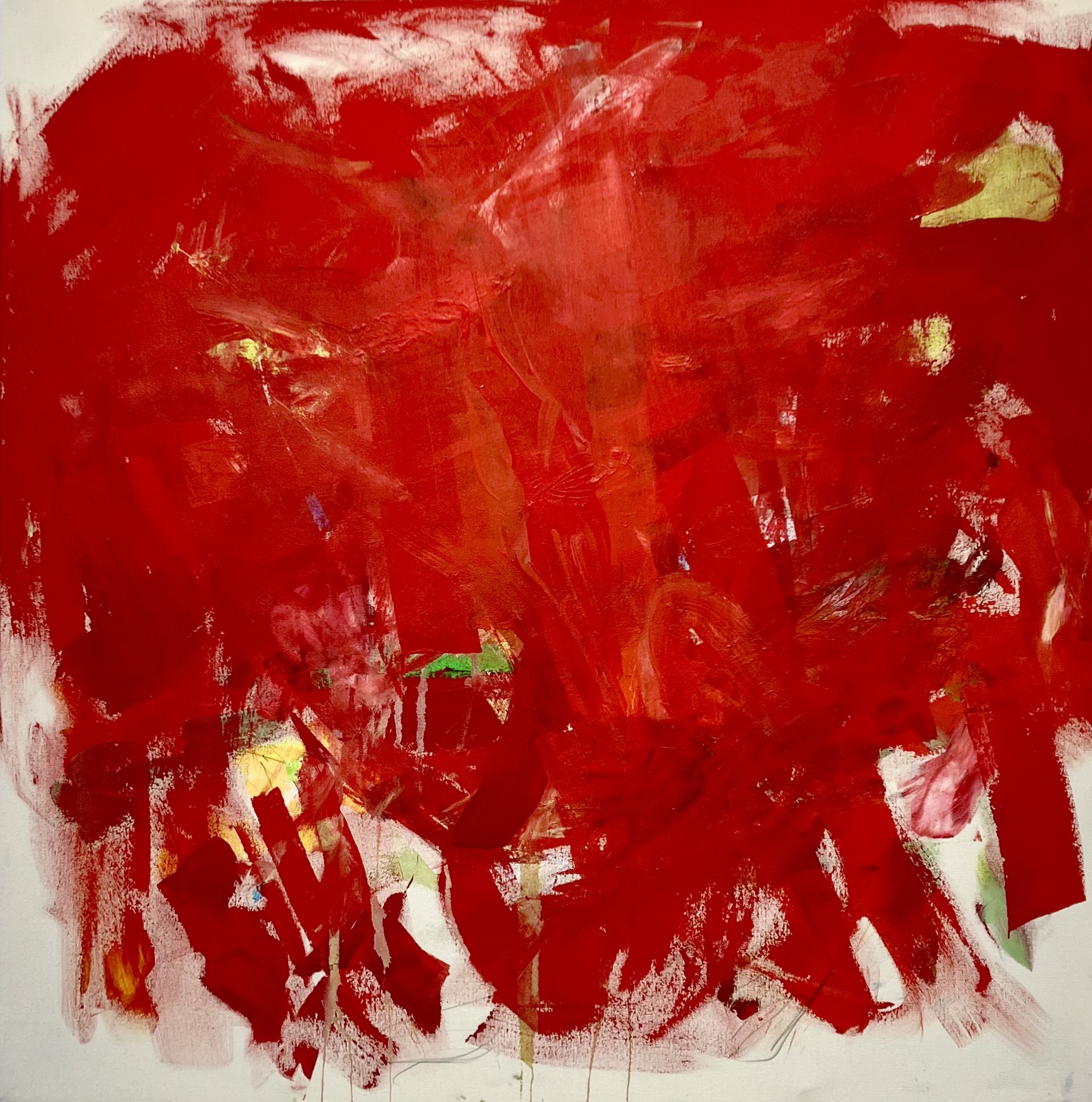
As for me, the painting, and with it the exhibition, may be read not as a record of a particular experience, but as evidence that the threshold above has been crossed—that point at which duration begins to alter perception, and the place, no longer external, starts to reorganise the interior. In this sense, the painting sits within the continuum described: between the impulse to relinquish and the persistence of what remains. The surface, saturated almost entirely in red, resists reading as landscape or memory in any direct sense; instead, it operates as a field of accumulation, where gestures layer without hierarchy, pressing toward density rather than resolution. Broad sweeps, reworked passages, and glazed areas fold into one another, while fleeting interruptions—small flashes of green, yellow, and white—remain partially obscured, suggesting not progression but interruption and return, as though earlier states persist beneath the surface, never fully displaced.
It is not expressive in the sense of release, but in the sense of having stayed long enough for everything—memory, sensation, unease, residue—to collapse into a single register. The painting does not abandon experience entirely, but neither does it describe it; instead, it holds it in suspension, where the residue of encounter remains active but unresolved. This is not a journey outward but a movement inward: the horizontal dispersal of experience gathering into vertical compression, where the act of painting becomes the site at which “enough” is negotiated—never declared, but felt as a density reached through duration.
If the road once promised arrival, this journey offers no such assurance. Nothing here resolves into conclusion; nothing declares itself complete. Instead, we are left within the same condition that produced the work: a sustained attentiveness, a negotiation between holding on and letting go, between presence and residue. “Enough” does not arrive as an answer, but as a feeling—one that cannot be measured, only sensed. And perhaps this is where the work settles: not at an end point, but within a state of ongoing passage, where meaning does not accumulate, but deepens through staying.
Greg Shaw,
Harare, 2026

