Originally published as a catalogue essay for Chicago Dzviti: Portrait of Zimbabwe | Mifananidzo yeZimbabwe, at The Arches @ Aberfoyle, Honde Valley, 2025.
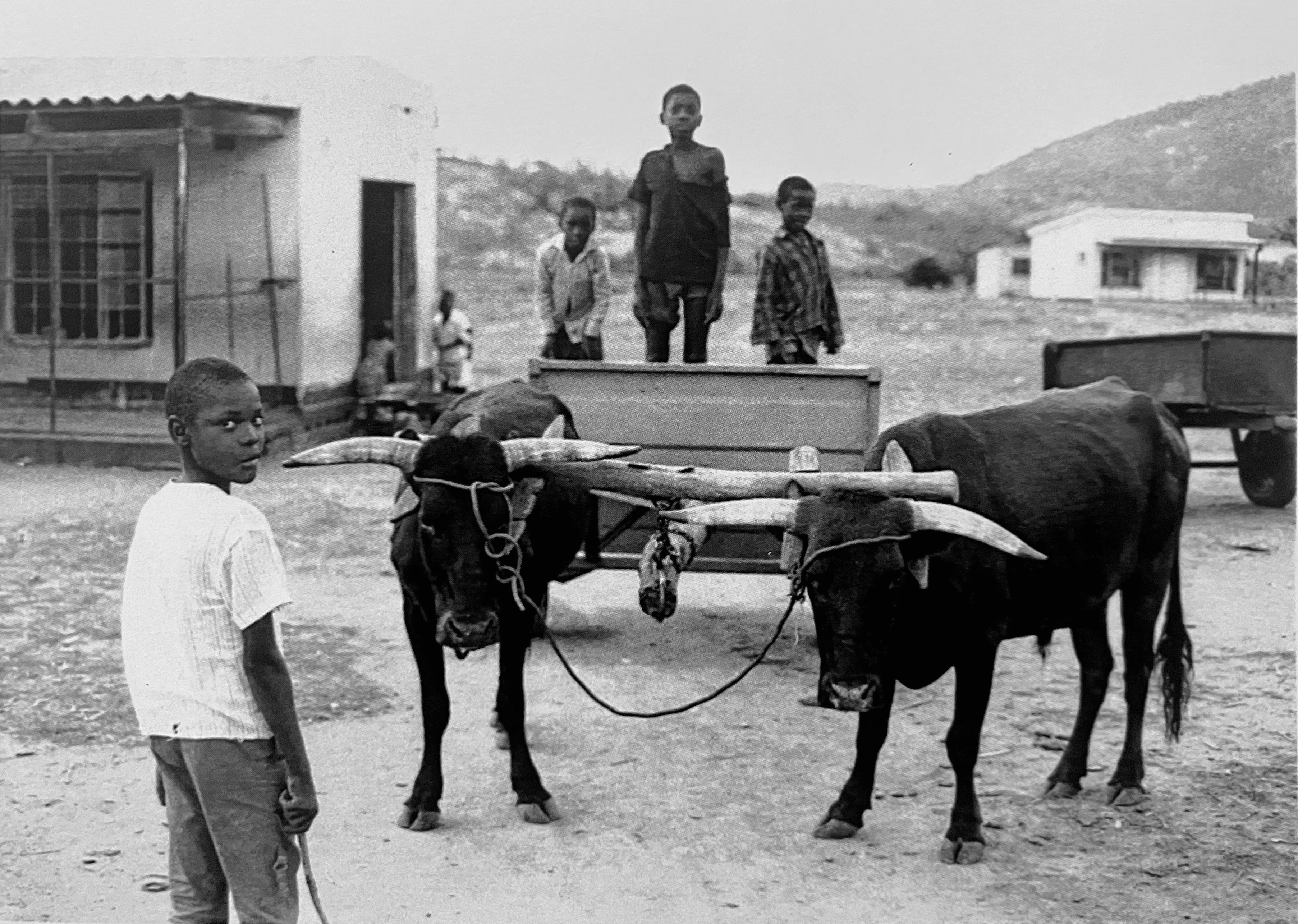
Throughout the body of work, Chicago Dzviti’s subjects are not simply accompanied by objects, but rather intrinsically connected to them. This is not incidental, but reflects a conscious choice by the artist to construct, include or exclude so that each object becomes an extension of identity, history and endeavour. The rural boys are not simply with their ox-cart (Rural boys with ox-cart); it is their pedestal, their chariot, a means to elevate them to the apex of a pyramid as obvious as Raphael’s Madonna del Prato. Their cart is well maintained, as are their oxen. Figures and beasts both form part of the structure; as each figure confronts the spectator, so do the beasts. This coherent, harmonious whole offers a narrative that runs beyond a portrait of the subjects. The image becomes a window to themes of ownership, pride, responsibility, labour and a relationship between humans, their world and the endeavours of survival.
The role of objects in art-historical discourse extends beyond that of mere props to the human subject. In Bourdieu’s terms, the object forms part of the subject’s habitus, carrying economic, social, symbolic and cultural capital, whilst Bill Brown’s “thing theory” suggests that when an object “asserts itself” in the viewer’s perception, it moves beyond utility and demands interpretation, having become a “thing” in its own right. In Dzviti’s portraits, the object functions as a parallel voice, mediating the spectator’s understanding of the subject, whilst maintaining both its symbolic and material attributes. In the interplay between subject, artist and spectator, lies an internal dialogue between person and object, subject and thing.
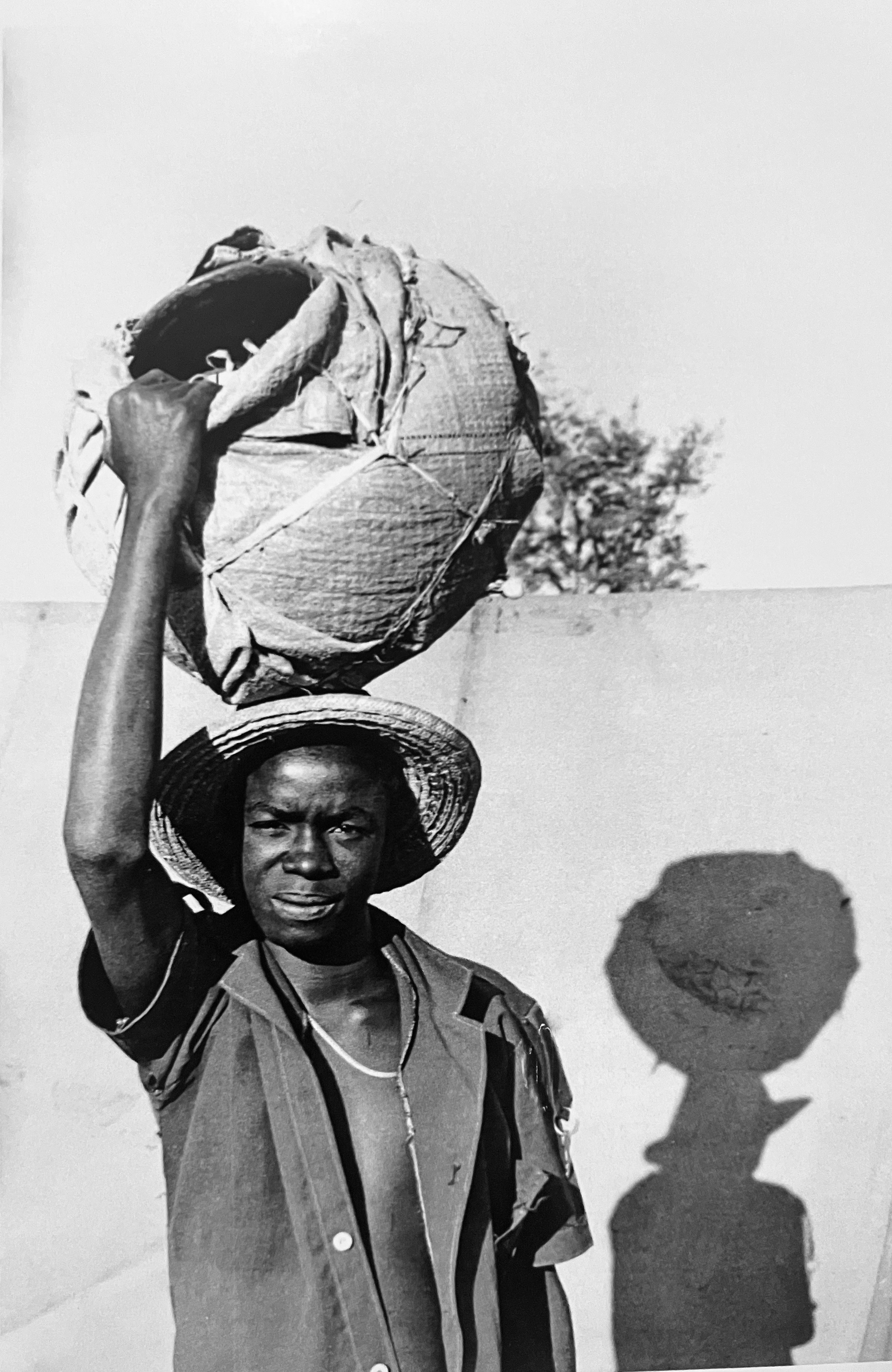
The returning refugee (Mozambican refugee carrying clay pot wrapped for transport) faces the viewer with an impassive gaze. Elliptical motifs throughout the composition visually bind figure and object — the clay pot, wrapped for protection. Pictorial space is reduced entirely, demarcated only by the ashen wall painted with the figure’s shadow. There is no world beyond the framed image; no geography, no history, no sense of time. The stripping away of external information compels the viewer to confront the figure and consider his possession. Subject and object, individual and universal. The object becomes a locus of meaning, wrapped and bound with crude materials—protected. It is a portable archive, a site where history is embedded: a symbol of displacement, survival and return. Of what is valued, and of what must be retained.
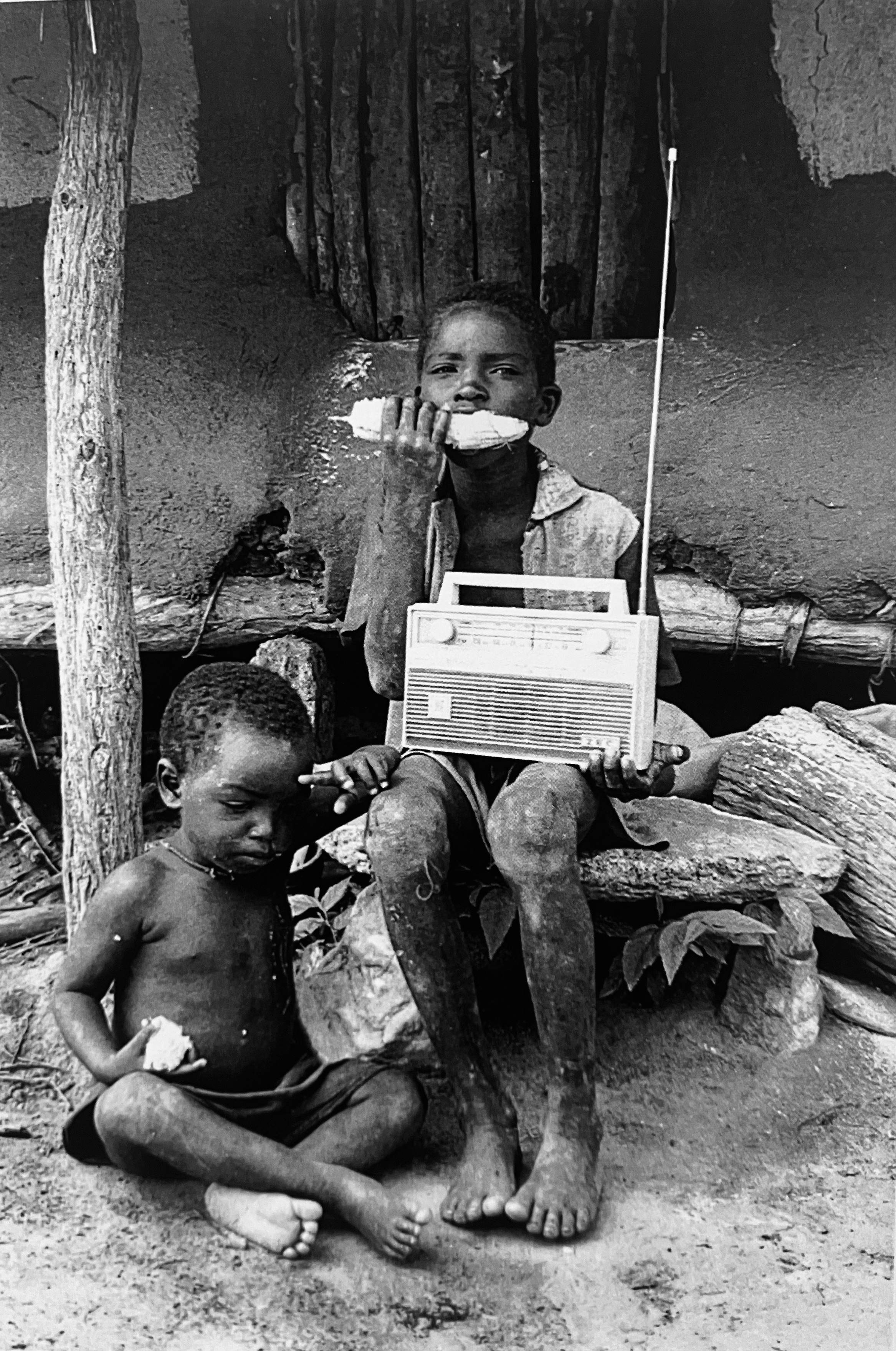
Two boys sit in a manner reserved for kinship—close, trusting and at peace (Boys eating maize with a radio). Their quiet posture, together with hints of a rural home describes a scene that is domestic, protected and safe. Both eat maize from the cob whilst the older boy holds a radio—an object whose shape and look would be instantly familiar in Zimbabwe at that time. The absence of cooking facilities, other listeners or a wider setting, gives these objects—the maize and the radio—the same symbolic weight as the wrapped pot. Together, they can be read as a pairing; the local and the far-reaching, self-sustenance and self-reliance against a backdrop of national and global connection. The historical context adds nuance: a period of economic adjustment (ESAP) and severe drought left rural communities vulnerable, reliant on government food relief and donor programmes. At the same time only four radio stations were available, all run by the ZBC—whatever information, entertainment or news arrived over the airwaves came through a carefully mediated pipeline. The world described above is broader than that of the Mozambican refugee, but neither is romanticised or sentimental. This is an image shaped by local histories, scarcities and connections—a world specific to Zimbabwe.
These objects, so clearly visible, run throughout Dzviti’s work. The photograph is never a neutral or objective record, but a construct shaped as much by exclusion as inclusion. Dzviti masterfully employs this principle to examine the subject/object relationship, ensuring that objects retain a clear, direct and significant role in the composition; the wrapped pot without a world, a radio without a crowd— each gaining symbolic weight through its isolation. His portraits go beyond mere representations of people, becoming an interrogation of the complex entanglement between humans and the objects they hold, carry or use. These objects emerge as markers of identity and stores of cultural history which stand equal to their subjects. Dzviti reveals not only who these people are, but the particular worlds the inhabit, and which their objects illuminate.
Greg Shaw
Harare, 2025

